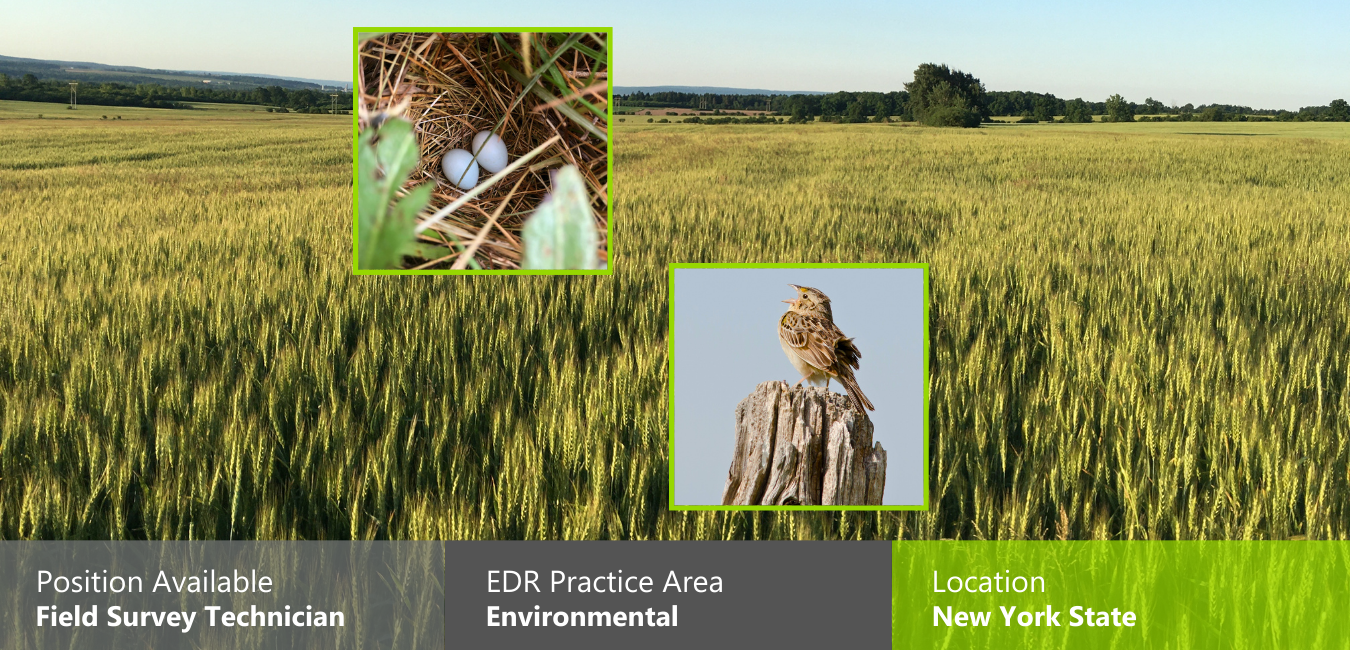
EDR is looking to hire qualified Field Survey Technicians to conduct avian surveys at proposed project sites in New York State. These positions are temporary (i.e., on a per-project or per-season basis) but may be extended depending on additional project opportunities and job performance. Avian surveys will primarily involve early morning breeding grassland bird surveys in rural settings; however, these positions may also include early morning/early evening marsh bird surveys, daytime forest raptor surveys, and/or evening winter raptor surveys at the same project sites.
A majority of the positions will be full-time, at approximately 40 hours per week. Although full-time availability is preferred, candidates interested in part-time positions are also encouraged to apply. For this role, Field Survey Technicians will be expected to drive to and from project sites, hike to and from designated survey locations, conduct surveys to identify birds by sight and sound, record data and map species observations electronically using mobile applications, provide daily progress updates, process data, and review work products to ensure completeness and accuracy.
Schedule and Compensation:
- Anticipated Start and End Dates: onboarding and training for breeding bird surveys and marsh bird surveys in April or May 2026; field surveys beginning in mid-April, late April, or early May, depending on project needs and candidate availability to start work, and ending in late July or early August. Forest raptor survey work will be conducted between mid-June and late July. Optional part-time work for evening winter raptor surveys may be available for select projects. Onboarding and training for winter raptor surveys will occur in February or early March, depending on candidate availability, with surveys concluding in early April.
- Weekly Schedule: Monday through Friday; 8-10 hours per day is typical (up to 40+ hours weekly); part-time work schedules (i.e., about 10-30 hours weekly) may also be arranged. Work hours for breeding and marsh bird surveys will typically begin well before sunrise, with surveys ending before midday. Forest raptor surveys are conducted during daytime hours, and winter raptor surveys require evening work hours after sunset.
- Compensation: $20 to $25 per hour (based on prior experience and work history with EDR).
- Lodging: hotel stays will be reimbursed when overnight travel is needed for multi-day survey efforts in a given work week, although most assignments will require daily commuting to and from project sites without hotel stays.
- Transportation: personal vehicle mileage reimbursed at the federal rate for work travel (currently $0.725 per mile in 2026) and calculated based on EDR office locations. As an alternative, rental vehicles and fuel reimbursement for work travel may be available depending on individual project requirements.
- Meal Per Diem: dependent on individual project requirements, but typically available at a rate of $20 in 2026 on workdays with early morning surveys (i.e., breeding and/or marsh bird surveys) or evening surveys (i.e., marsh bird or winter raptor surveys). Meal per diem also provided for overnight travel based on project location, with standard rates of $51 for the first and last day of travel and $68 for days that are neither the first nor last day of travel.
- Equipment: mobile device (e.g., iPad mini), data sheets and clipboard, audio speaker, stylus, headlamp, traffic safety cones, first aid kit, and safety vest are all provided by EDR for work use.
- Safety: all employees will adhere to EDR health and safety procedures and employment policies, including project-specific job hazard analysis.
Qualifications:
- At least one (1) field season or one (1) year of experience conducting breeding bird, marsh bird, wintering raptor, migratory raptor, or other similar bird surveys (in a professional or scientific research capacity). Additional field seasons or years of experience preferred.
- A strong proficiency in bird identification, including New York State rare species and raptors. Familiarity with New York State endangered, threatened, and special concern species preferred.
- The ability to readily identify avian species that occur in New York State by sight and sound (or ability to quickly learn to identify such species).
- The willingness to travel, including possible overnights, to project sites located throughout New York State.
- A current, valid driver’s license.
- The ability to work atypical hours (e.g., morning (before sunrise), evening (after sunset)).
- The ability to work outdoors in a variety of harsh weather conditions (e.g., cold, wind, rain, heat, high humidity, insects).
- Physical endurance to conduct avian field surveys in areas without road access (e.g., walking on uneven and/or muddy terrain, hiking through dense and/or thorny vegetation, snowshoeing through deep snow).
- A positive attitude, enthusiasm for teamwork, and appreciation for both the challenges and benefits of working in an outdoor field environment.
- Independence and ability to conduct field surveys alone (following successful completion of training).
- Excellent written and oral communication skills that allow for accurate, complete data recording and punctual delivery of survey data and progress updates.
- The ability to carry equipment (i.e., binoculars, spotting scope, tripod, mobile device, personal items) while conducting fieldwork.
- Proficiency in reading, understanding, and navigating using aerial (satellite) imagery maps.
- The ability to fill out paper and electronic data sheets.
- The ability to accurately record detailed spatial, identification, and behavioral information for birds observed during surveys with a high level of proficiency.
- Attention to detail and ability to conduct quality control (QC) reviews of survey data to ensure accuracy and completeness.
- A bachelor’s degree or coursework in biology, conservation biology, ecology, environmental science, environmental studies, natural resources, wildlife science, or a related field.
EDR is a woman-owned multi-disciplinary environmental consulting and design firm that has been in business for over 45 years, and this position represents a career opportunity with one of the leading environmental permitting consultants for renewable energy projects in the Eastern United States. Significant milestones in our portfolio include the largest proposed utility-scale solar project in Maryland (Great Bay Solar), the first wind energy project built in New York (Madison), the first wind energy project approved in Ohio (Buckeye), the first approved offshore wind project (Cape Wind), the first built offshore wind project (Block Island), the first proposed offshore wind project in the Great Lakes (Project Icebreaker), the largest wind energy project in the Northeast (Maple Ridge), and the first wind energy project proposed on National Forest Service Lands (Deerfield Wind). Our experience on these projects, along with many other ongoing/active projects, incorporates all aspects of environmental impact analysis and permitting, which includes preparation of environmental impact statements and siting board applications in addition to various support studies and permit applications.
EDR’s staff is a diverse group of environmental professionals that includes ecologists, botanists, wetland specialists, wildlife biologists, GIS specialists, archaeologists, historians, visualization specialists, planners, landscape architects, and engineers. Come join our team, work on interesting and challenging projects, and collaborate with our talented group of environmental professionals!
Applicants must be currently authorized to work in the United States on a full-time basis. No sponsorship is available for this position.
EDR is an Equal Opportunity Employer. We do not discriminate against any applicant or employee because of race, color, age, national origin, citizenship status, ethnicity, religion, creed, marital status, disability, sexual orientation, sex/gender, and any other legally protected characteristic.
To apply for this position, please submit your cover letter and resume below.